

Waec 2026 Economics Essay/Objective questions and answers for school candidates >> 2026/2027 waec ssce Economics thoery verified expo for may/june candidates
FOR WAEC SSCE 2026 QUESTIONS & ANSWERS, WHATSAPP MR BEN: 09151288084
WAEC ECONOMICS QUESTIONS AND ANSWERS 2026/2027 SUBSCRIPTION PRICE & PROCEDURES BELOW.
=> DIRECT SMS SUBSCRIPTION: For Direct sms Answers to your phone. Transfer #1,000 to our bank details and drop your receipt for confirmation.
=> WHATSAPP RUNS SUBSCRIPTION: You will be added to E-Class Whatsapp (V.i.p) Group where you will receive the Question & Answers. Transfer #800 to our bank details and drop your receipt for confirmation.
=> PASSWORD LINK SUBSCRIPTION: You will receive a code and link where you will view the Question & Answers. Transfer #600 to our bank details and drop your receipt for confirmation.
WAEC Economics essay/objective questions and answers 2026 for may/june candidates
WAEC EXPO 2026 BULK SUBSCRIPTION DETAILS
(i) ALL SUBJECTS Whatsapp Group: N12,000
======================================
(ii) ALL SUBJECTS Password link: N9,000
======================================
(iii) ALL SUBJECTS Direct SMS: N20,000
======================================
(iv) 7/8/9 Subjects on Whatsapp Group (Plus Practicals): N7,000
======================================
(v) 7/8/9 Subjects + Practicals(Direct SMS): N10,000
======================================
(vi) 7/8/9 Subjects WITHOUT Practicals(Direct SMS): N7,000
======================================
(vii) 6 Subjects + Practicals (Direct Mobile): N6,500 [N5,500 without practicals]
======================================
(viii) 5 Subjects + Practicals: (Direct SMS) N5,500 [N5,000 without practicals]
======================================
(ix) PASSWORD LINK Payment for 8/9 subjects + or – practicals: N5,000
======================================
(x) Direct SMS Payment Per Subject: N1000
======================================
(xi) Direct Mobile Payment Per Practical: N800
======================================
(xii) Password Link payment per subject: N500
======================================
(xiii) Password Link Payment per Practical: N600
======================================
(xiv) For School Whatsapp group (This is for group of people that are up to 20 in numbers, and wants me to add them in one group together where i can be posting answers for them, specifically on WHATSAPP): Chat me up on whatsapp: 09151288084. I will guide you on what to do.
PAYMENT METHOD
Payment is made via bank transfer
AFTER SUBSCRIPTION Send;
(i) Bank name/Depositors name.
(ii) Subjects
(iii) Date of Payment & Amount Paid.
(iv) Phone number to us via whatsapp only [09151288084]
Also view:
WAEC 2026 Mathematics Expo
PREVIOUS YEAR WAEC ECONOMICS PAST QUESTIONS AND ANSWERS
Question 1
The equilibrium position of a firm is illustrated in the diagram below. Study the diagram and answer the questions that follow.
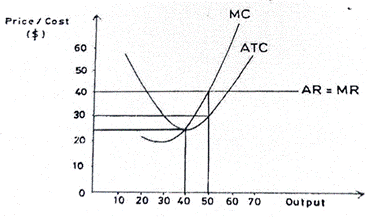
(a) Determine the firm’s:
(i) equilibrium output level;
(ii) equilibrium price.
(b) At the equilibrium output level, calculate the firm’s:
(i) total cost;
(ii) total revenue;
(iii) total profit.
(c) Is the firm operating in the long-run or short-run? Explain your answer.
(d) (i) What type of market is the firm operating in?
(ii) List three features of the market type identified in (d)(i).
Observation
This is one of the data response questions and most of the candidates who attempted it scored above average marks. Most of the candidates who attempted the (a) part of the question were able to identify the equilibrium output level and price correctly, however, a few candidates wrongly stated the output level and price combination associated with the point where MC = ATC i.e. 40 units and $25 instead of the combination associated with the point where MC = MR. Few candidates also omitted the unit of measurement when providing answers to the (b) part e.g. total cost expressed in dollars ($). Some candidates were also unable to identify the period in which the firm was operating based on the type of profit earned in the (c) part.
The correct answers:
(a) (i) Equilibrium output level = 50 units
(ii) Equilibrium price = $ 40.00
(b) (i) Total cost (TC) = AC × Q
= $ 30 × 50
= $ 1500
(ii) Total revenue (TR) = AR × Q
= $ 40 × 50
= $ 2000
(iii) Profit = TR – TC
= $ (2000 – 1500)
= $ 500
OR
Profit = (AR – AC) × Q
= $ (40 – 30) × 50
or
= $ 10 × 50
= $ 500
(c) The firm is operating in the short-run because it is operating in a perfect market and it made abnormal/super normal profit, where its price > average cost and average cost < average revenue. (d) (i) Perfectly competitive market/perfect market. (ii) - There are many buyers and sellers. - There is free entry and exit into and from the market. - Sellers are price takers/there is one market clearing price/there is no government intervention. - There is perfect knowledge about the market. - There are no extra transport costs incurred. - Goods sold are homogeneous. - There is no preferential treatment.
Question 2
Table 1 below represents the output levels of a firm producing hand sanitizer. Use the information to answer the questions that follow.
Table 1
Output (units)
0
10
18
28
36
45
If the cost function of the firm is given as C = 30 + 4q, where C is the total cost and q is the units produced, calculate the:
(a) total cost in dollars of producing:
(i) 18 units;
(ii) 36 units.
(b) average cost in dollars of producing:
28 units;
45 units.
(c) What is the marginal cost in dollars of producing 28 units?
(d) Determine the profit made from producing 45 units when the market price is fixed at $ 5.00 per unit.
(e) Determine the fixed cost of the firm. Explain your answer.
Observation
This is the alternative data response question, majority of the candidates who attempted this question scored above average marks. Few of the candidates did not show the full workings required in arriving at the answers to the (a), (b), (c) and (d) parts of the question; some omitted formulae while others missed important steps in the calculations. Few candidates were unable to calculate marginal cost in the (c) part. Some other candidates could not also explain why fixed cost is $30 in the (e) part of the question thereby losing valuable marks.
The correct answers:
(a) (i) TC18 = 30 + 4 (18) = 30 + 72 = $ 102
(ii) TC36 = 30 + 4 (36) = 30 + 144 = $ 174
(b) (i) AC28 = TC28 = 30 + 4 (28) = 142 = $ 5.07 or $ 5.1
28 28 28
(ii) AC45 = TC45 = 30 + 4 (45) = 210 = $ 4.67 or $ 4.7
45 45 45
(c) MC28 = TC28 – TC18 = (30 + 4 (28)) – (30 + 4 (18)) = 142 – 102 = $ 4.00
28 – 18 28 – 18 10
(d) Profit = TR – TC = ($ 5 × 45) – $ 210
= $ (225 – 210)
= $ 15
(e) Fixed cost of the firm is $ 30 when q = 0, C = 30 + 4 (0) = $ 30
or At output 0, Total Fixed Cost incurred is $ 30.
Question 3
(a) Distinguish between:
(i) money cost and opportunity cost;
(ii) normal good and inferior good.
(b) Explain how the scale of preference assists the following economic groups in making efficient allocation of their resources:
(i) individuals;
(ii) firms;
(iii) governments.
Observation
This question was popular among the candidates. Some of them lost marks because they provided a one sided explanation when distinguishing normal goods from inferior goods in the (a) part of the question. Some of the candidates were unable to give strong answers in the (b) part, most of them focused on explaining scale of preference as a concept without exploring how scarcity necessitates choice and how the tool assists the listed economic units in allocating their resources. The performance of candidates in this question was average.
The correct answers:
(a) (i) Money cost is the expenses in terms of money incurred to produce or to have commodity.
While opportunity cost or real cost is the alternative forgone or that which has to be sacrificed to have a commodity.
(ii) A normal good is a good for which its demand increases when income increases and demand decreases when income decreases. While an inferior good is a good for which its demand tends to fall when income rises and its demand rises when income falls.
(b) (i) When an individual is faced with the problem of limited resources, a scale of preference will enable such an individual to order/arrange his wants according to which one gives the highest amount of satisfaction/is urgently needed/is the most important. He will then allocate his resources to obtain the want that gives the highest amount of satisfaction.
(ii) A firm is also faced with the problem of limited resources needed to produce everything it wants. It will therefore rank its production according to which product will give the highest amount of satisfaction which is measured in terms of profit. The firm will therefore allocate its resources according to which product gives the highest amount of profit.
(iii) Government is also faced with the problem of limited resources/revenue. It cannot therefore produce all the goods and services it wants. It will therefore rank the goods and services according to which one will give the citizenry the highest amount of well-being or welfare. It will therefore allocate the resources to produce such goods and services.
Question 4
(a) Define economic system.
(b) Distinguish between a capitalist economy and a socialist economy under the following:
(i) aim of production;
(ii) consumer sovereignty;
(iii) competition.
(c) State three features of land as a factor of production.
Observation
This was also a popular question. In the (a) part of this question, most candidates were able to define economic system but, few of them were able to recognize the difference between the economic systems listed above in terms of the specific features in the (b) part of the question. The performance of candidates in this question was average.
The correct answers:
(a) (i) An economic system is the social, legal and institutional framework for the management of resources in an economy.
OR
An economic system is any arrangement adopted by a country to manage the scare resources of the country effectively.
(b) (i) Aim of production
In capitalism, the aim of production is to make profit so goods and services are being produced on a large scale.
In socialism, the aim of production is to provide for the welfare of the citizens by making goods and services available at low/affordable prices.
(ii) Consumer sovereignty
In capitalism, the consumer is king as it is he who dictates what is to be produced through his purchases. The consumer’s taste drives production.
In socialism, consumers’ demands are determined by government so they have little or no influence on what is produced.
(iii) Competition
Since profit is the motive in capitalism, competition exists and it ensures efficiency and this leads to production of high quality goods that attract customers.
In socialism, there is no competition since government decides what is to be produced. Government is the sole producer and this can lead to production of low quality goods.
(c) (i) Land is a natural gift and has a zero cost of production.
(ii) The supply/size of land is fixed and cannot be increased or decreased.
(iii) The quality of land can be degraded if not used with care.
(iv) Land has many uses which are both short-term (farming, fishing) and long-term (roads, dams, factories)
(v) The value of land depends upon its location. Land in urban centres cost higher than land in rural areas.
(vi) Land is subject to diminishing returns if the right number of a variable factor is not applied to it.
(vii) Land is geographically immobile.
(viii) Land is heterogeneous. Its quality varies, some may be more suitable for residential purposes than for other purposes.
(ix) The reward for land is rent.
Question 5
(a) Differentiate between a sole proprietorship and a partnership.
(b) List four characteristics of a sole proprietorship.
(c) Outline four advantages of a public limited liability company.
Observation
This was the most popular question. Most of the candidates who attempted this question were able to define a sole proprietorship in the (a) part of the question, but failed in defining a partnership in terms of its accurate membership limit, for instance, some wrongly defined a partnership as having two or more members. Some of the candidates merely listed the advantages of public limited liability companies and did not explain the points raised in the (c) part of the question. Candidates’ performance was average in this question.
The correct answers:
(a) (i) A sole proprietorship is a type of business owned and controlled by an individual with the primary aim of maximizing profit.
While, a partnership is a type of business set up by two to twenty members with a common goal of making profits.
(b) (i) It is set up by a single person who bears all risks.
(ii) Capital is provided by only the owner either from his personal savings, inheritance etc.
(iii) He enjoys all the profits since he provides the capital alone.
(iv) He manages and controls the business alone.
(v) It is not a legal entity because the business is not separate from the owner.
(vi) His death or incapacitation may lead to a collapse of the business.
(vii) He has unlimited liability since losses could extend to his private property.
(viii) Decision making is easy and fast because he does not need to consult other people.
(ix) It is easy to establish because not many legal formalities are needed.
(c)(i) It can raise large capital through the sale of shares.
(ii) It enjoys economies of scale because it can easily expand output or its size of operation.
(iii) It can sue and be sued because it is a legal entity.
(iv) There is continuous existence if a member withdraws or dies because shares are legally transferable.
(v) It enjoys limited liability since shareholders lose only capital invested in times of bankruptcy.
(vi) Shares can be transferred easily through the stock exchange market.
(vii) It is easy for them to get loans from the banks because they have the necessary collateral.
(viii) It can attract highly qualified specialists and experts to ensure efficiency and enjoy economies of scale.
(ix) Ownership is separate from the management to improve corporate governance.
(x) Business risks are shared among many shareholders.
Be the first to comment