

Waec 2026 chemistry Essay/Objective questions and answers >> 2026/2027 waec ssce chemistry thoery verified expo for may/june candidates
FOR WAEC SSCE 2026 QUESTIONS & ANSWERS, WHATSAPP MR BEN: 09151288084
WAEC CHEMISTRY QUESTIONS AND ANSWERS 2026/2027 SUBSCRIPTION PRICE & PROCEDURES BELOW.
=> DIRECT SMS SUBSCRIPTION: For Direct sms Answers to your phone. Transfer #1,000 to our bank details and drop your receipt for confirmation.
=> WHATSAPP RUNS SUBSCRIPTION: You will be added to E-Class Whatsapp (V.i.p) Group where you will receive the Question & Answers. Transfer #800 to our bank details and drop your receipt for confirmation.
=> PASSWORD LINK SUBSCRIPTION: You will receive a code and link where you will view the Question & Answers. Transfer #600 to our bank details and drop your receipt for confirmation.
WAEC physics essay/objective questions and answers 2026 for may/june candidates
WAEC EXPO 2026 BULK SUBSCRIPTION DETAILS
(i) ALL SUBJECTS Whatsapp Group: N12,000
======================================
(ii) ALL SUBJECTS Password link: N9,000
======================================
(iii) ALL SUBJECTS Direct SMS: N20,000
======================================
(iv) 7/8/9 Subjects on Whatsapp Group (Plus Practicals): N7,000
======================================
(v) 7/8/9 Subjects + Practicals(Direct SMS): N10,000
======================================
(vi) 7/8/9 Subjects WITHOUT Practicals(Direct SMS): N7,000
======================================
(vii) 6 Subjects + Practicals (Direct Mobile): N6,500 [N5,500 without practicals]
======================================
(viii) 5 Subjects + Practicals: (Direct SMS) N5,500 [N5,000 without practicals]
======================================
(ix) PASSWORD LINK Payment for 8/9 subjects + or – practicals: N5,000
======================================
(x) Direct SMS Payment Per Subject: N1000
======================================
(xi) Direct Mobile Payment Per Practical: N800
======================================
(xii) Password Link payment per subject: N500
======================================
(xiii) Password Link Payment per Practical: N600
======================================
(xiv) For School Whatsapp group (This is for group of people that are up to 20 in numbers, and wants me to add them in one group together where i can be posting answers for them, specifically on WHATSAPP): Chat me up on whatsapp: 09151288084. I will guide you on what to do.
PAYMENT METHOD
Payment is made via bank transfer
AFTER SUBSCRIPTION Send;
(i) Bank name/Depositors name.
(ii) Subjects
(iii) Date of Payment & Amount Paid.
(iv) Phone number to us via whatsapp only [09151288084]
PREVIOUS YEAR WAEC CHEMISTRY PAST QUESTIONS AND ANSWERS
Question 1
(a) What is transition element? [2 marks]
(b) Consider the electron configuration of the following elements:
A= 2: 8:6; B = 2: 8:2; C = 2:8:1; D = 2:8:8
State the element which forms a:
(i) doubly charged cation;
(ii) soluble trioxocarbonate (IV).
[2 marks]
(c) Explain briefly why there is a general increase in the first ionization energies of the elements across the period in the periodic table.
[2 marks]
(d) Give two examples of an aliphatic compound.
[2 marks]
(e) Explain briefly why alkanols are stronger bases than water
[3 marks]
(f) State the major raw materials used in the solvay process.
[3 marks]
(g) What is geometric isomerism?
[2 marks]
(h) Give a reason why water gas is a better fuel than producer gas.
(i) Define the term heat o/’combustion.
(j) (i) State Faraday second law of electrolysis.
(ii) Calculate the amount of silver deposited when 10920 coulombs of
electricity is passed through a solution of a silver salt.
[IF = 96500 c mol-1]
[5 marks]
Observation/Solution
This question was compulsory for all candidates and their performance was average.
In part (a), majority of the candidates could not define a transition element.
In part (b), majority of the candidates stated the element which forms a doubly charged cation and soluble trioxocarbonate (IV).
In part (c), majority of the candidates explained why there is a general increase in the irst ionization energies o the elements across the period in the periodic table.
In part (d), majority of the candidates gave two examples of an aliphatic compound.
In part (e), majority of the candidates could not explain why alkanols are stronger bases than water.
In part (f), majority of the candidates stated the major raw materials used in the solvay process.
In part (g), majority of the candidates could not define geometric isomerism.
In part (h), majority of the candidates gave a reason why water gas is a better fuel than producer gas.
In part (i), majority of the candidates stated Faraday’s second law of electrolysis. However, few candidates were able to calculate the amount of silver deposited when 10920 coulombs of electricity is passed through a solution of a silver salt if 1F =96500 C mol-1).
The correct answers:
(a) A transition element is one which has incompletely filled d-orbitals.
(b) (i) B
(ii) C
(c) Across a period (from left to right) there is a gradual increase in the number of protons in the nucleus / effective nuclear-charge. This increases the force of attraction between the nucleus and the electrons, hence more energy is needed to remove the outermost electron.
(d) – methane
– ethene
– ethyne
– ethanol
– ethanoic acid
(e) – Alkanols are formed by replacing one hydrogen of water by an alkyl group (1)
– Alkyl groups have a positive inductive effect / are electron releasing/ electron donating
– This increases the electron density of the oxygen
(f) – NaCl
– CaCO3
– NH3
– C
(g) Geometric isomerism is the existence of two compounds with the same molecular formula but differ in the arrangement of groups attached to the carbon containing the double bond
(h) This is because constituents of water gases (CO and H2) are both combustible and give a higher calorific / heat value than producer gas.
(i) It is defined as the heat change/ released when 1 mole of a substance is burnt in excess oxygen
OR
It is defined as the heat change/ released when 1 mole of a substance is completely burnt in air
(j) (i) When the same quantity of electricity is passed through different electrolytes, the relative number of moles of the elements discharged are inversely proportional to the charges on the ions of the element.
(ii) 96500 C liberates 1.0 mol of Ag(s)
∴ 10920 C will liberate 10920
96500
= 0.113 mole
Question 2
(a) In an experiment, 20.0cm3 of a solution containing 4 g dm-3 of sodium hydroxide was
neutralized by 8.0 cm3 of dilute tetraoxosulphate (IV) acid:
(i) write a balanced equation for the reaction;
(ii) calculate the concentration of the acid in mol dm-3
(b) (i) State two postulates of the Kinetic theory of gases which real gases do not obey.
(ii) Explain briefly why real gases do not obey the postulates stated in 2(b)(i) [6 marks]
(c) Consider the following compound:
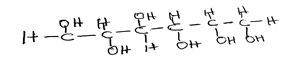
(i) name the compound;
(ii) name the two structural isomers of the compound;
(iii) state the chemical process involved in the preparation of the compound from
starch;
(iv) write the chemical equation for the steps involved in the process in 2(c)(iii);
(v) name two enzymes involved in the process in 2(c)(iii)
[10 marks]
(d) Explain briefly the term structural isomerism
[3 marks]
Observation/Solution
This question was popular among the candidates and their performance was average.
In part (a), majority of the candidates were able to write and balance the neutralization reaction between NaOH and H2SO4.
In part (b), majority of the candidates could not state two postulates of the Kinetic theory of gases which real gases do not obey, and could not explain why real gases do not obey the stated postulates.
In part (c), majority of the candidates did not answer this question, and those who did could not name the compound correctly, and few o them could state the chemical process involved in the preparation of the compound from starch.
In part (d), majority of the candidates were able to explain structural isomerism.
The correct answers:
2 (a)
(i) H2SO4 + 2NaOH → Na2 SO4 + 2H2O
(ii) Concentration of NaOH (CB)
CB = 4/40
= 0.1 mol dm-3
CAVA = 1
CBVB 2
CA x 8 = 1
0.1 x 20 2
CA = 0.1 x 20 x 1
2 x 8
= 0.125 mol dm-3
Alternative method
CB = 4/40 = 0.1 moldm-3
VB = 20/1000 = 0.02dm3
nB = 0.1 x 0.02 = 0.002 mol
∴ nA = 0.002/2 = 0.001 mol
8 cm3 of acid ≡ 0.001 mol
∴ 1000 cm3 = 0.0018 x 1000
= 0.125 moldm-3
(b) (i) – The volume of a gas is negligible compared to the total volume of the container
– There are no forces of attraction or repulsion between molecules of the gas / collision
between molecules are elastic
(ii) The volume of a gas is not negligible because at high pressure the molecules occupy
volume which is appreciable and at low temperature the intermolecular forces of
attraction and repulsion become significant
(c) (i) – Glucose
(ii) – Fructose
– Galactose
(iii) -hydrolysis
(d) – Is the existence of compounds with the same molecular formula but
different structural formulae / arrangement of the atoms / linkage of the atoms
Question 3
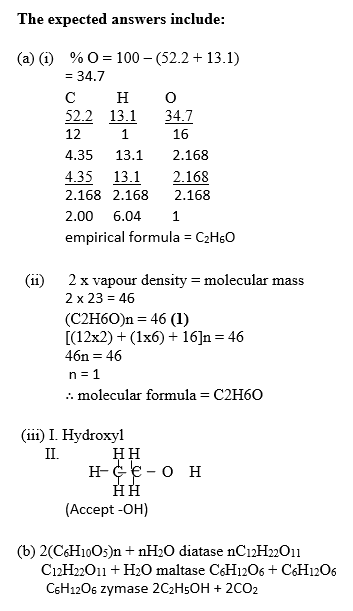
(a) A compound contains 52.2% C, 13.1 % H and Oxygen only. The vapour density of the
compound is 23.
(i) Determine its empirical formula.
(ii) Determine its molecular formula.
(iii) The compound reacts with sodium metal to produce hydrogen gas and when
warmed with acidified KMnO4(aq) gives a solution which turns from purple to colourless.
It also forms a sweet smelling liquid when heated with ethanoic acid in the presence of concentrated H2SO4.
(I) name the functional group present in the compound;
(II) draw the structural formula of the compound
[H = 1.0, C = 12.0, O = 16.0]
[10 marks]
(b) Outline the chemical equations for the production of ethanol from cooked cassava.
[6 marks]
(c) (i) Explain briefly why a piece of aluminium does not react with water.
(ii) How can a pure sample of aluminium chloride crystals be prepared from aluminium. [6 marks]
(d) Describe how water can be separated from aqueous CuSO4.
[3 marks]
Observation/Solution
Majority of the candidates did not answer this question satisfactorily, but they did well in question (a).
In part (a), majority of the candidates were able to determine the empirical formula and the molecular formula of the compound.
In part (b), majority of the candidates could not outline the chemical equations for the production of ethanol from cooked cassava.
In part (c), majority of the candidates were able to explain why a piece of aluminium does not react with water. In addition, they were able to describe how a pre sample of aluminium chloride crystals could be prepared from aluminium.
In part (d), majority of the candidates could not describe how water could be separated from aqueous CuSO4.
The correct answers:
(c) (i) The reaction starts but the metal produces a layer of an oxide / aluminium oxide
Layer on its surface which is impermeable (to water) and stops the reaction.
(ii) Add dilute hydrochloric acid to excess aluminium filter off the excess
Metal leave filtrate in a warm place / evaporate filtrate to point of crystallization/ leave in the sun
(d) – The flask is connected to condenser and the solution is heated. The water vaporizes and is
converted to (liquid) water in the condenser.
How can a student become successful in his/her exams